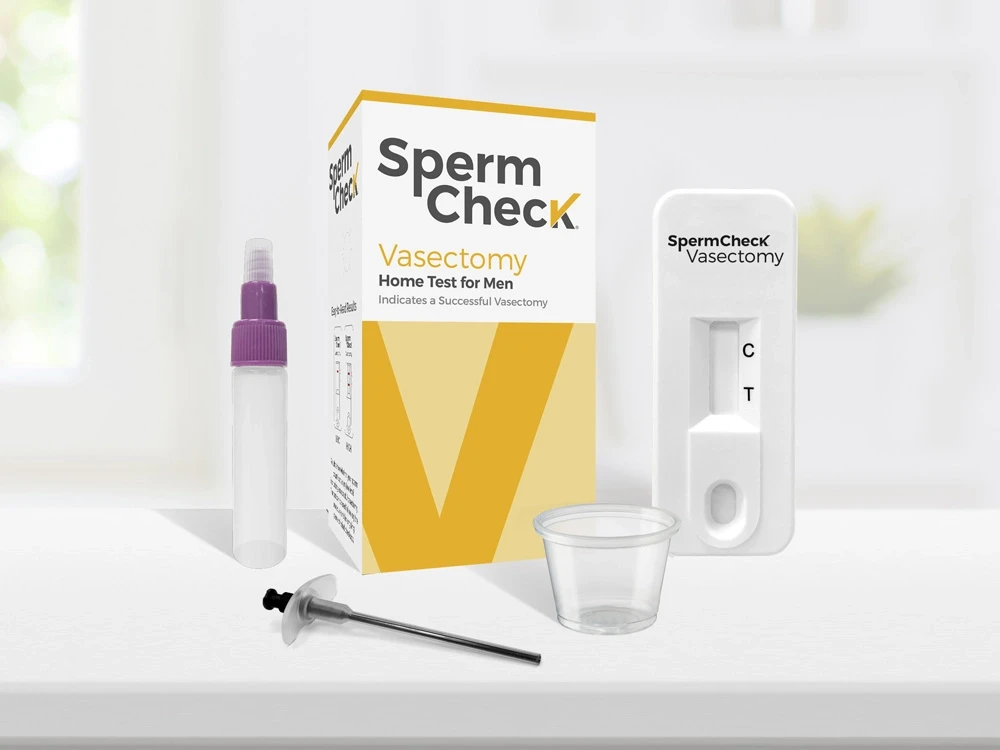
Ensure you are no longer fertile with a post-vasectomy sperm test at home.
A surprise pregnancy following vasectomy can happen, yet 50% of men who have the procedure never check their sperm count again. If you have had a vasectomy, urologists recommend testing at least twice following the procedure and once a year afterwards to ensure you are no longer fertile. The vasectomy test kit from SpermCheck is an easy home-based solution for post-vasectomy testing—no waiting room required.
As many as one in 100 vasectomies may fail to prevent pregnancy within 5 years of the procedure. Don’t guess about your sperm count—get accurate information with this easy vasectomy test kit. Kit includes two (2) tests! It is fast, accurate, and convenient.
The SpermCheck Vasectomy Kit contains everything you need to perform 2 tests. You should follow your doctor’s instructions about how long to wait after your vasectomy before performing the tests. The usual recommendation is to perform 2 tests within 2-4 months following the procedure, and then once a year thereafter.
The results of both tests should be negative. If they are not both negative, then test again with another SpermCheck Vasectomy kit until you receive two consecutive negative results.
£6 9
A: SpermCheck Vasectomy is a home-screening test to detect sperm in semen following a vasectomy and it can also be used yearly to confirm ongoing sterility. It is a simple test that quickly lets you know when your post-procedure sperm count has dropped to a very low level, indicating a successful vasectomy. No matter the result of your sperm-count test, it is important to have a discussion with your doctor before discontinuing birth control.
A: Yes, this is an accurate and proven home test for post-vasectomy sperm count. SpermCheck measures the levels of SP-10, a protein only present in the head of a sperm. Using lateral-flow immunoassay (similar to a home pregnancy test), results indicate either a high (>250,000 sperm/milliliter) or low (
A: Urologists recommend testing sperm at least twice following a vasectomy procedure: generally at 60 days and then again at 90 days, to ensure sperm levels have dropped to a low level. Be sure to follow your doctor’s specific recommendations.
A: No. This product is only for post-vasectomy individuals and cannot be used by men trying to help their partners conceive. You can learn about SpermCheck Fertility here .
Have questions or need assistance? Contact our team.
DDC
1st Floor, WeWork
184 Shepherds Bush Road
London
W6 7NL

Something that really cooks. Alright, alright this is an oldie, but uh, it’s an oldie where I come from. Alright guys, let’s do some blues riff in b, watch me for the changes, and uh, try and keep up, okay. Yeah. Calvin, why do you keep calling me Calvin? Marty, will we ever see you again? George, there’s nothing to be scared of. All it takes is a little self confidence. You know, if you put your mind to it, you could accomplish anything.
George. George. I’m too loud. I can’t believe it. I’m never gonna get a chance to play in front of anybody. What? Aw yeah, everything is great. I think I know exactly what you mean.
That’s Calvin Klein, oh my god, he’s a dream. Back to the future. Nah, I just don’t think I’m cut out for music. C’mon.
Lorem ipsum dolor sit amet, consectetur adipiscing elit, sed do eiusmod tempor incididunt ut labore et dolore magna aliqua. Ut enim ad minim veniam, quis nostrud exercitation ullamco laboris nisi ut aliquip ex ea commodo consequat. Duis aute irure dolor in reprehenderit in voluptate velit esse cillum dolore eu fugiat nulla pariatur. Excepteur sint occaecat cupidatat non proident, sunt in culpa qui officia deserunt mollit anim id est laborum.
Lorem ipsum dolor sit amet, consectetur adipiscing elit, sed do eiusmod tempor incididunt ut labore et dolore magna aliqua. Ut enim ad minim veniam, quis nostrud exercitation ullamco laboris nisi ut aliquip ex ea commodo consequat. Duis aute irure dolor in reprehenderit in voluptate velit esse cillum dolore eu fugiat nulla pariatur. Excepteur sint occaecat cupidatat non proident, sunt in culpa qui officia deserunt mollit anim id est laborum.
Lorem ipsum dolor sit amet, consectetur adipiscing elit, sed do eiusmod tempor incididunt ut labore et dolore magna aliqua. Ut enim ad minim veniam, quis nostrud exercitation ullamco laboris nisi ut aliquip ex ea commodo consequat. Duis aute irure dolor in reprehenderit in voluptate velit esse cillum dolore eu fugiat nulla pariatur. Excepteur sint occaecat cupidatat non proident, sunt in culpa qui officia deserunt mollit anim id est laborum.
New DNA testing in a 2010 Houston murder case has led to the exoneration of one man — after nine years behind bars — and the arrest of another.
Lydell Grant, 43, was found guilty of stabbing 28-year-old Aaron Scheerhoorn to death in the vicinity of a nightclub on the sworn testimony of multiple witnesses, according to reports. He was cleared last month — and released from prison — after DNA obtained from Sheerhorn’s fingernails was tested, using new technology. He was serving a life sentence.
On Thursday, Jermarico Carter, 41, was charged with the murder after the same DNA linked him to the crime. Investigators got a match to his DNA using an FBI database containing the DNA of convicted criminals, Fox 26 Houston reported Sunday.
“On behalf of the Houston Police Department, I want to extend an apology to Mr. Grant and his family as they have waited for justice all these years,” Houston Police Chief Art Acevedo said Friday on Twitter. Acevedo said Carter “has recently confessed to his role in Mr. Scheerhoorn’s killing.” Carter was in custody in Georgia on unrelated charges, the chief said.
Grant said Saturday that he wasn’t mad at Grant for sitting in jail for a crime he committed, Fox 26 reported. “I’m not mad at him at all,” he said, according to the station. “I forgive him because he know now what he did.”
The station reported that as of Saturday Grant no longer had to wear an ankle monitor or abide by a curfew. Houston prosecutors said they will move for Grant’s formal exoneration before the Texas Court of Criminal Appeals. Grant’s lawyer Mike Ware of the Innocence Project of Texas was quoted by The Associated Press as saying that he believes erroneous witness identifications based on outdated and flawed techniques used by detectives helped to wrongly convict his client.
Mistaken witness identifications contributed to more than 70 percent of the more than 360 wrongful convictions in the U.S. that have been overturned by post-conviction DNA evidence, according to the Innocence Project.
